Full or partial entries of my blogs may be found at LatviansOnline http://latviansonline.com/forum/ + Forum Home + Open Forum – The-Not-Voter. If you copy this blog for your files, or copy to forward, or otherwise mention its content, please credit the author http://esoschronicles.blogspot.com/, http://melnaysjanis.blogspot.com/, or http://the-not-voter.blogspot.com/
I suggest you look at the links imbedded in these blogs or at the end of the blog as an integral part of my argument.
THE-NOT-VOTER
26 Latvia’s Leaders As Geopolitical Dunces
In my previous blog (25), I pointed out the gutlessness of the Latvian political leadership. Anyone who votes for any of the would be leaders in the upcoming elections is not only acting on the irrational hope that somehow matters will improve (re: hope dies last), but that irrationality is in and of itself what hope is about. The disgusting circus in the air to a dumbed down crowd gathered on the shores of Daugava in Riga just about sums up the level of maturity of both organizers and the entertained.
While the right wing coalition of the former Prime Minister Shkehle and hyperventilating vice major of Riga Shlesers are waging an election campaign that has turned economics into a form of the mindless, “Vienotība” (Unity), another coalition of right wing political parties, has turned the fear of Soviet invasion in 1944 [“The Swedes are coming (to save us)”] into a hysterical fear of Russia in 2010. The allegedly non-Latvian “Russian” leadership (concentrated about Riga) offers—as its contribution to the pre-election babble--deathlessness to destitute pensioners by promising no further cuts in pensioners pensions and further daredevil air shows above Daugava. Not ot to be outdone, the leadership of Catholic, Lutheran, and Russian Orthodox has reached such ecumenical highs that Tony Blair, the former British PM, could well become the next Pope.
Meanwhile, the geopolitical unification of East and West, that is to say, Europe-West (the EU) and Europe-East (Russia) proceeds apace. Of course, the economic links precede political links and may take a hundred years to reach completion. Nevertheless, as the project Nord Stream proves, the linking is taking place. Oh, yes, Latvia is not having any of it. Thus, not only did modern technology pass Latvian by using an underwater pipeline, but Lithuania, Poland, and others are denying Latvian agricultural products export to Russia by taking the paranoia of Russia for the psychological disorder that it in fact is.
The Latvian paranoia of all things Russian has created a “death spiral” not only in its economy (a Bloomberg reporter on a trip to Riga interviews a Swedish economist on Latvia’s economy), but in demographic and geopolitical status. The geopolitical nihilism can be grasped by anyone who wishes to look at the map and notice that Latvia is located just about in the middle between Western and Eastern Europe. In short, Latvia’s much talked about geopolitical advantage is being denied in the name of a democracy that has become a synonym for irresponsible politicians and politics.
The mushy thinking among Latvia’s political elite is one of the reasons why I have been suggesting that the only vote in the upcoming elections is to NOT-VOTE. Among the earliest NOT-VOTER supporters is Thomas Jefferson, who argued for nullification, i.e., the right of the citizenry to nullify everything from laws to governments. The basis for Jefferson’s argument is that it is the people who are the sovereign, with government acting on their behalf only as long as the people not NOT-VOTE and de-authorize it.
Incidentally, were the Latvian “Russians” to win the elections (not without Latvian support, of course), the result can in no way be worse than the political chaos that prevails at present. In fact, next to a successful NOT-VOTE, which leads to a revamping of a dysfunctional Constitution, a Latvian-"Russian" political coalition is the next logical step if the people of Latvia wish for themselves more than become a near-nameless domain for bureaucrats.
Asterisks & Links of Interest
Compulsory voting in the EU Parliamentary elections
http://www.ceps.eu/files/book/1886.pdf
The abstentionist elephant
http://www.spiked-online.com/index.php/site/article/8783/
Electronic polls
http://news.bbc.co.uk/2/hi/technology/10102126.stm
On the Meaning of Voting
http://www.strike-the-root.com/92/bylund/bylund1.html
British Government Attempts to Bracket the Constitution
http://news.bbc.co.uk/2/hi/uk_news/politics/election_2010/8681624.stml
Ground Zero for Thought
http://www.alternet.org/module/printversion/146989
Why Forced Positive Thinking Is A Lot Of Crock?
http://www.alternet.org/story/146940/barbara_ehrenreich%3A_why_forced_positive_thinking_is_a_total_crock?page=2
The Trap
http://www.youtube.com/watch?v=uAluyt5_kic
Showing posts with label not-vote. Show all posts
Monday, August 23, 2010
Wednesday, August 18, 2010
Full or partial entries of my blogs may be found at LatviansOnline http://latviansonline.com/forum/ + Forum Home + Open Forum – The-Not-Voter. If you copy this blog for your files, or copy to forward, or otherwise mention its content, please credit the author http://esoschronicles.blogspot.com/ , http://melnaysjanis.blogspot.com/ , or http://the-not-voter.blogspot.com/
I suggest you look at the links imbedded in these blogs or at the end of the blog as an integral part of my argument.
THE-NOT-VOTER
24 A President For Something
The President of Latvia, Valdis Zatlers, tells the press that he does not know who to vote for.
This voter does not know who to vote for either and does not expect that by some miracle he will before the elections are over.
This is one of the reasons why I have been suggesting that the only vote in the upcoming elections is to NOT-VOTE. The greater significance of a NOT-VOTE can be discovered by reading my preceding blogs. Incidentally, among the earliest NOT-VOTER supporters is Thomas Jefferson, who argued for nullification, i.e., the right of the citizenry to nullify everything from laws to governments. The basis for Jefferson’s argument is that it is the people who are the sovereign, with government acting on their behalf only as long as the people not NOT-VOTE and de-authorize it.
Asterisks & Links of Interest
Compulsory voting in the EU Parliamentary elections
http://www.ceps.eu/files/book/1886.pdf
The abstentionist elephant
http://www.spiked-online.com/index.php/site/article/8783/
Electronic polls
http://news.bbc.co.uk/2/hi/technology/10102126.stm
On the Meaning of Voting
http://www.strike-the-root.com/92/bylund/bylund1.html
British Government Attempts to Bracket the Constitution
http://news.bbc.co.uk/2/hi/uk_news/politics/election_2010/8681624.stml
Ground Zero for Thought
http://www.alternet.org/module/printversion/146989
Why Forced Positive Thinking Is A Lot Of Crock?
http://www.alternet.org/story/146940/barbara_ehrenreich%3A_why_forced_positive_thinking_is_a_total_crock?page=2
The Trap
http://www.youtube.com/watch?v=uAluyt5_kic
I suggest you look at the links imbedded in these blogs or at the end of the blog as an integral part of my argument.
THE-NOT-VOTER
24 A President For Something
The President of Latvia, Valdis Zatlers, tells the press that he does not know who to vote for.
This voter does not know who to vote for either and does not expect that by some miracle he will before the elections are over.
This is one of the reasons why I have been suggesting that the only vote in the upcoming elections is to NOT-VOTE. The greater significance of a NOT-VOTE can be discovered by reading my preceding blogs. Incidentally, among the earliest NOT-VOTER supporters is Thomas Jefferson, who argued for nullification, i.e., the right of the citizenry to nullify everything from laws to governments. The basis for Jefferson’s argument is that it is the people who are the sovereign, with government acting on their behalf only as long as the people not NOT-VOTE and de-authorize it.
Asterisks & Links of Interest
Compulsory voting in the EU Parliamentary elections
http://www.ceps.eu/files/book/1886.pdf
The abstentionist elephant
http://www.spiked-online.com/index.php/site/article/8783/
Electronic polls
http://news.bbc.co.uk/2/hi/technology/10102126.stm
On the Meaning of Voting
http://www.strike-the-root.com/92/bylund/bylund1.html
British Government Attempts to Bracket the Constitution
http://news.bbc.co.uk/2/hi/uk_news/politics/election_2010/8681624.stml
Ground Zero for Thought
http://www.alternet.org/module/printversion/146989
Why Forced Positive Thinking Is A Lot Of Crock?
http://www.alternet.org/story/146940/barbara_ehrenreich%3A_why_forced_positive_thinking_is_a_total_crock?page=2
The Trap
http://www.youtube.com/watch?v=uAluyt5_kic
Saturday, July 3, 2010
Full or partial entries of my blogs may be found at LatviansOnline + Forum Home + Open Forum – The-Not-Voter. If you copy this blog for your files, or copy to forward, or otherwise mention its content, please credit the author and http://the-not-voter.blogspot.com/ or to this bloggers main site at http://esoschronicles.blogspot.com/
I suggest you look at the links imbedded in these blogs or at the end of the blog as an integral part of my argument.
THE-NOT-VOTER
21 Where To?
A survey by Factum, published at the Latvian portal “Delfi” (July 2nd), tells that if elections were to occur in the month of June, the political parties would get their deputies or seats in about the following order:
29 seat to the “Center of Tooning” (Saskaņas centrs).
24 seats to “Unity” (Vienotība);
18 seats to the “Greens” and “Farmers” coalition;
15 seats to “LNNK” and “Visu Latvijai” coalition;
9 seats to “TP” and “LPP” coalition; and
5 seats to “Human Rights in United Latvia” (Par cilvēku tiesībām…).
A crude and perhaps oversimplified interpretation of the East or West political divide and tilt of the above mentioned is 29 East; 24, 18, 15, 9 West; 5 East (=100).
If we speculate and create yet other coalitions among the coalesced, then
29 Tooning +5 Human Rights = 34
24 Unity, +18 Greens & Farmers, +15 LNNK & VL, +9 TP & LPP = 66
In other words, 34 seats tilt toward the East and 66 seats tilt toward the West. If we presume that this split of seats remains in force after the elections, Latvia is in effect divided in two geopolitical regions, re Riga-Daugavpils vs the rest of Latvia. Riga is of course Latvia’s engine of wealth under the current political and economical setup.
While the number of seats favoring one or the other side of the geopolitical divide changes over time, the two states within one system continues in effect. The system is in existence from about the time of the reestablishment of Latvia (1991) as a sovereign nation.
The political and economic instability that has arisen from the two-state setup is increased by the fact that the Latvian government’s tilt-West has its de jure seat in Riga, even as Riga is controlled (de facto) by the tilt-East. This tells itself best when we see that the government of Latvia [its governors (deputies, ministers, etc.)] is composed of mostly Latvians, all tilting West (yet have their seats in Riga), while the mayor of Riga and his executive body are all tilting East.
Because the economic interests of the elites of the East and West are concentrated in Riga, whatever the political differences between the two, these are smoothed over by their business interests. Generally speaking the business attitude of these business interests is neocapitalistic, a mix of American, German, and Russian characteristics at their worst. This smoothing of the differences with regard to commercial interests (however rough) occurs at the expense of Latvians who live impoverished in the countryside. This has resulted in an exodus of about 200,000 Latvians (mostly laborers and their children) to the far abroad of England, Ireland. Reports from the Latvian countryside speak of vast stretches of near empty, sparsely settled land, especially in the regions of Latgale and Vidzeme. The ruins of farmsteads of a more populous Latvia lie in ruins, in abandoned apple orchards, inns, and mute trees about a house that once was.
One may argue that Latvia has not only one, but two apartheid systems. One is the already mentioned political East-West divide; the other is the economic divide between the well to do of both East and West vs the poor of the East and West.
Though the above is an oversimplification of the political and economic pie, it correctly points to why political misalignments serve to impoverish (also: dumb down) Latvians. The condition encourages the political arm of the business elite to encourage divisionism among the people of Latvia, which keeps the various ethnicities of Latvia permanently on edge with regard to each other. Thus, for example, no ethnic group is able to work toward a new cultural syncretism in Latvia, but practices political reactionism. This short-changes creativity and harms economic development.
There are some geopolitical solutions to the political-economic knot, which--though amenable to solution--do not lend themselves to a solution under Latvia’s “natural” democratic divisions. They are solvable only by means of an authoritarian system the purpose of which is to revised the "ņatural" democratic system into an “open” democratic system.
My pet dog "Not-Vote" (the real one is called Pekse), tells me to go NOT-VOTE (abstain from voting) during the October elections. If the NOT-VOTE is successful, it will force the Latvian Saeima to resign or become a de facto dictorship under an authoritarian President of its choice. That could lead to a circus. However, the Saeima may also resign, hold new elections (which are unlikely to change much), or call for a four to six year moratorium on “natural” democracy. After an interiam authoritarian democratic leadership that works to create an "open" democratic society with fully "open" elections, Latvia should emerge (with some oversight by the European Union) a new culture or one at least with such a potential.
One of the aims of Latvia’s authoritarian government ought to be the redirection of Latvia’s economic development, away from a vaguely defined system of “exports” by whatever businesses that finds a home in Latvia, and move toward a more precisely defined area of economic interest, less short-term, more future embracing. The future embracing ought to focus on
a) genetics-medicine, especially practical genetics such as cloning; this could be more easily done in Latvia, because the sense of unsettlement in Latvian society may enable individuals to accept radical changes in attitude more freely. This may enable a readjustment in the laws of Latvia in such a way that these favor issues such as cloning, for example. The controversy surrounding cloning is largely artificial, albeit seeming real;
b) cloned individuals will necessarily create new household structures; this in turn will create at the university a separate department on Future Households, one next to sociology and anthropology;
c) the right to die;
d) regeneration of Latvia’s population not necessarily through an increased birth rate, but by creating an image in which Latvia sees itself as a room in a household which is happy to see our neighbors come for a visit as our conditions permit, but we may be distinctly unhappy if other than accustomed room-mates were to come to stay; and
e) taking advantage of a declining population and redefining the character of the nation; for example, why not a decision to leave behind the glass and concrete cancer that is chewing away on its tail, the agricultural economy, and come to live in a virtual city in what may become a forest dwellers’ economy.
No, the forest dweller of our time is unlikely to go back to live in a hollow tree stump or under uprooted trees, or in caves. Rather, he-she will live in an environment that
1. knows all about genetics and related medicine,
2. rethinks life-death issues,
3. restructures its family system into a system of households,
4. assures community identity under conditions of falling population numbers,
5. reforests the land by letting itgo fallow, and
6. accumulating capital by being the first on the planet to institute laws that allow movement in radically different directions.
Thus, Latvia may exit from the political and economic fiasco into a new society.
* * *
Of course, the differentiation by the media of the Latvian community by its ethnicities and languages makes the above imagined NOT-VOTE not possible.
A peculiar Latvian meme or thought-block blocks the Latvian people to a predisposition to conservativism without tolerance for opposition. The latter results from the many historical traumas to which proto-Latvians and Latvians have been exposed to over the centuries. The thought-block is so stuborn that it resists overcoming itself even if a failure to resist leads to suicide.
This is why the entry of Guntis Ulmanis, the first Latvian president (1993-1999) of a reconstituted (and remade) Latvia, is a highly charged and, thus, radicalizing and reorienting situation. It could change not only the face (surface) of Latvia, but the way Latvians see themselves.
The situation at this moment is only a story. Nevertheless, the parallels between Mr. Guntis Ulmanis [whose grandfather was the brother of the “soft” authoritarian President Kārlis Ulmanis (1934-1940] and Shakespeare’s King Lear are striking and thought provoking. True, Ulmanis is not as hoary in his age as King Lear was.
By reentering the elections on behalf a two highly suspect (of corruption) businessmen [and rationalizing his entry by stating that the leaders of the two respective parties (TP & LPP) have become “better” men], Guntis Ulmanis puts the blunted edge of politics to the whetting stone and stakes both his forebear's and his own reputation on this potentially existential act. At stake is the honor of not only Guntis Ulmanis personally, but Latvia, too. The existential question whirls about the thoughts that come over what happens when the two parties that Guntis Ulmanis has agreed to front, thank Ulmanis for bringing them an election victory, then tell him as King Lear’s two daughters told their father: “Thanks, dad, for the kingdom; now be off to Old Pensioners Home”?
Does Mr. Ulmanis have a radical answer to the hypothetical—nevertheless real—likelihood that messieurs Shkehle and Shlesers give him the hi-ho? And even if they were to be so generous and not do so, what does Ulmanis offer to do on behalf of Latvia for his part? Will he be a neutered or an authoritarian democrat? Will he do what needs to be done to turn Latvia around and into tomorrow, or does he let the boat continue drifting Westward and on into the sunset?
Asterisks & Other Readings
Compulsory voting in the EU Parliamentary elections
http://www.ceps.eu/files/book/1886.pdf
The abstentionist elephant
http://www.spiked-online.com/index.php/site/article/8783/
Electronic polls
http://news.bbc.co.uk/2/hi/technology/10102126.stm
On the Meaning of Voting
http://www.strike-the-root.com/92/bylund/bylund1.html
British Government Attempts to Bracket the Constitution
http://news.bbc.co.uk/2/hi/uk_news/politics/election_2010/8681624.stml
Ground Zero for Thought
http://www.alternet.org/module/printversion/146989
Why Forced Positive Thinking Is A Lot Of Crock?
http://www.alternet.org/story/146940/barbara_ehrenreich%3A_why_forced_positive_thinking_is_a_total_crock?page=2
The Trap
http://www.youtube.com/watch?v=uAluyt5_kic
If you copy this blog for your files, or copy to forward or otherwise mention its content, please credit the author and http://esoschronicles.blogspot.com or http://the-not-voter.blogspot.com or http://melnaysjanis.blogspot.com/ . You are invited to view them all to make heads and tails of it all.
I suggest you look at the links imbedded in these blogs or at the end of the blog as an integral part of my argument.
THE-NOT-VOTER
21 Where To?
A survey by Factum, published at the Latvian portal “Delfi” (July 2nd), tells that if elections were to occur in the month of June, the political parties would get their deputies or seats in about the following order:
29 seat to the “Center of Tooning” (Saskaņas centrs).
24 seats to “Unity” (Vienotība);
18 seats to the “Greens” and “Farmers” coalition;
15 seats to “LNNK” and “Visu Latvijai” coalition;
9 seats to “TP” and “LPP” coalition; and
5 seats to “Human Rights in United Latvia” (Par cilvēku tiesībām…).
A crude and perhaps oversimplified interpretation of the East or West political divide and tilt of the above mentioned is 29 East; 24, 18, 15, 9 West; 5 East (=100).
If we speculate and create yet other coalitions among the coalesced, then
29 Tooning +5 Human Rights = 34
24 Unity, +18 Greens & Farmers, +15 LNNK & VL, +9 TP & LPP = 66
In other words, 34 seats tilt toward the East and 66 seats tilt toward the West. If we presume that this split of seats remains in force after the elections, Latvia is in effect divided in two geopolitical regions, re Riga-Daugavpils vs the rest of Latvia. Riga is of course Latvia’s engine of wealth under the current political and economical setup.
While the number of seats favoring one or the other side of the geopolitical divide changes over time, the two states within one system continues in effect. The system is in existence from about the time of the reestablishment of Latvia (1991) as a sovereign nation.
The political and economic instability that has arisen from the two-state setup is increased by the fact that the Latvian government’s tilt-West has its de jure seat in Riga, even as Riga is controlled (de facto) by the tilt-East. This tells itself best when we see that the government of Latvia [its governors (deputies, ministers, etc.)] is composed of mostly Latvians, all tilting West (yet have their seats in Riga), while the mayor of Riga and his executive body are all tilting East.
Because the economic interests of the elites of the East and West are concentrated in Riga, whatever the political differences between the two, these are smoothed over by their business interests. Generally speaking the business attitude of these business interests is neocapitalistic, a mix of American, German, and Russian characteristics at their worst. This smoothing of the differences with regard to commercial interests (however rough) occurs at the expense of Latvians who live impoverished in the countryside. This has resulted in an exodus of about 200,000 Latvians (mostly laborers and their children) to the far abroad of England, Ireland. Reports from the Latvian countryside speak of vast stretches of near empty, sparsely settled land, especially in the regions of Latgale and Vidzeme. The ruins of farmsteads of a more populous Latvia lie in ruins, in abandoned apple orchards, inns, and mute trees about a house that once was.
One may argue that Latvia has not only one, but two apartheid systems. One is the already mentioned political East-West divide; the other is the economic divide between the well to do of both East and West vs the poor of the East and West.
Though the above is an oversimplification of the political and economic pie, it correctly points to why political misalignments serve to impoverish (also: dumb down) Latvians. The condition encourages the political arm of the business elite to encourage divisionism among the people of Latvia, which keeps the various ethnicities of Latvia permanently on edge with regard to each other. Thus, for example, no ethnic group is able to work toward a new cultural syncretism in Latvia, but practices political reactionism. This short-changes creativity and harms economic development.
There are some geopolitical solutions to the political-economic knot, which--though amenable to solution--do not lend themselves to a solution under Latvia’s “natural” democratic divisions. They are solvable only by means of an authoritarian system the purpose of which is to revised the "ņatural" democratic system into an “open” democratic system.
My pet dog "Not-Vote" (the real one is called Pekse), tells me to go NOT-VOTE (abstain from voting) during the October elections. If the NOT-VOTE is successful, it will force the Latvian Saeima to resign or become a de facto dictorship under an authoritarian President of its choice. That could lead to a circus. However, the Saeima may also resign, hold new elections (which are unlikely to change much), or call for a four to six year moratorium on “natural” democracy. After an interiam authoritarian democratic leadership that works to create an "open" democratic society with fully "open" elections, Latvia should emerge (with some oversight by the European Union) a new culture or one at least with such a potential.
One of the aims of Latvia’s authoritarian government ought to be the redirection of Latvia’s economic development, away from a vaguely defined system of “exports” by whatever businesses that finds a home in Latvia, and move toward a more precisely defined area of economic interest, less short-term, more future embracing. The future embracing ought to focus on
a) genetics-medicine, especially practical genetics such as cloning; this could be more easily done in Latvia, because the sense of unsettlement in Latvian society may enable individuals to accept radical changes in attitude more freely. This may enable a readjustment in the laws of Latvia in such a way that these favor issues such as cloning, for example. The controversy surrounding cloning is largely artificial, albeit seeming real;
b) cloned individuals will necessarily create new household structures; this in turn will create at the university a separate department on Future Households, one next to sociology and anthropology;
c) the right to die;
d) regeneration of Latvia’s population not necessarily through an increased birth rate, but by creating an image in which Latvia sees itself as a room in a household which is happy to see our neighbors come for a visit as our conditions permit, but we may be distinctly unhappy if other than accustomed room-mates were to come to stay; and
e) taking advantage of a declining population and redefining the character of the nation; for example, why not a decision to leave behind the glass and concrete cancer that is chewing away on its tail, the agricultural economy, and come to live in a virtual city in what may become a forest dwellers’ economy.
No, the forest dweller of our time is unlikely to go back to live in a hollow tree stump or under uprooted trees, or in caves. Rather, he-she will live in an environment that
1. knows all about genetics and related medicine,
2. rethinks life-death issues,
3. restructures its family system into a system of households,
4. assures community identity under conditions of falling population numbers,
5. reforests the land by letting itgo fallow, and
6. accumulating capital by being the first on the planet to institute laws that allow movement in radically different directions.
Thus, Latvia may exit from the political and economic fiasco into a new society.
* * *
Of course, the differentiation by the media of the Latvian community by its ethnicities and languages makes the above imagined NOT-VOTE not possible.
A peculiar Latvian meme or thought-block blocks the Latvian people to a predisposition to conservativism without tolerance for opposition. The latter results from the many historical traumas to which proto-Latvians and Latvians have been exposed to over the centuries. The thought-block is so stuborn that it resists overcoming itself even if a failure to resist leads to suicide.
This is why the entry of Guntis Ulmanis, the first Latvian president (1993-1999) of a reconstituted (and remade) Latvia, is a highly charged and, thus, radicalizing and reorienting situation. It could change not only the face (surface) of Latvia, but the way Latvians see themselves.
The situation at this moment is only a story. Nevertheless, the parallels between Mr. Guntis Ulmanis [whose grandfather was the brother of the “soft” authoritarian President Kārlis Ulmanis (1934-1940] and Shakespeare’s King Lear are striking and thought provoking. True, Ulmanis is not as hoary in his age as King Lear was.
By reentering the elections on behalf a two highly suspect (of corruption) businessmen [and rationalizing his entry by stating that the leaders of the two respective parties (TP & LPP) have become “better” men], Guntis Ulmanis puts the blunted edge of politics to the whetting stone and stakes both his forebear's and his own reputation on this potentially existential act. At stake is the honor of not only Guntis Ulmanis personally, but Latvia, too. The existential question whirls about the thoughts that come over what happens when the two parties that Guntis Ulmanis has agreed to front, thank Ulmanis for bringing them an election victory, then tell him as King Lear’s two daughters told their father: “Thanks, dad, for the kingdom; now be off to Old Pensioners Home”?
Does Mr. Ulmanis have a radical answer to the hypothetical—nevertheless real—likelihood that messieurs Shkehle and Shlesers give him the hi-ho? And even if they were to be so generous and not do so, what does Ulmanis offer to do on behalf of Latvia for his part? Will he be a neutered or an authoritarian democrat? Will he do what needs to be done to turn Latvia around and into tomorrow, or does he let the boat continue drifting Westward and on into the sunset?
Asterisks & Other Readings
Compulsory voting in the EU Parliamentary elections
http://www.ceps.eu/files/book/1886.pdf
The abstentionist elephant
http://www.spiked-online.com/index.php/site/article/8783/
Electronic polls
http://news.bbc.co.uk/2/hi/technology/10102126.stm
On the Meaning of Voting
http://www.strike-the-root.com/92/bylund/bylund1.html
British Government Attempts to Bracket the Constitution
http://news.bbc.co.uk/2/hi/uk_news/politics/election_2010/8681624.stml
Ground Zero for Thought
http://www.alternet.org/module/printversion/146989
Why Forced Positive Thinking Is A Lot Of Crock?
http://www.alternet.org/story/146940/barbara_ehrenreich%3A_why_forced_positive_thinking_is_a_total_crock?page=2
The Trap
http://www.youtube.com/watch?v=uAluyt5_kic
If you copy this blog for your files, or copy to forward or otherwise mention its content, please credit the author and http://esoschronicles.blogspot.com or http://the-not-voter.blogspot.com or http://melnaysjanis.blogspot.com/ . You are invited to view them all to make heads and tails of it all.
Sunday, June 27, 2010
Full or partial entries of my blogs may be found at LatviansOnline + Forum Home + Open Forum – The-Not-Voter. If you copy this blog for your files, or copy to forward, or otherwise mention its content, please credit the author and http://the-not-voter.blogspot.com/ or to this bloggers main site at http://esoschronicles.blogspot.com/
I suggest you look at the links imbedded in these blogs or at the end of the blog as an integral part of my argument.
THE-NOT-VOTER
20 A Farce or a Welcome Tragedy
In my previous blog I suggested that Mr. Guntis Ulmanis, who exchanged the honorific of “Mr. President” for plain “Mr.” ought now prove his worthiness as ex-Mr. President with existential behavior. There are several ways Mr. Ulmanis may act existentially. The result will depend on whether he chooses farce or tragedy.
There is definitely something of the character of King Lear in the self-neutered former president of Latvia. We may remember that King Lear, feeling the age of retirement upon him, divides his kingdom between his two daughters, Goneril and Regan (TP and LPP?), but leaves Cordelia (Unity? = Vienotība?) out of his will.
Not surprisingly (at least not to those who have overcome naïvite), Mr. Lear learns to regret his decision. However, instead of taking action—to undo, or go hang, whatever—Lear falls into profound passivity, and with no less profound humiliation and a nightmarish storm berating the day, he tears off his clothes. Mr. Lear:
“Is man no more than this? Consider him well. Thou
owest the worm no silk, the beast no hide, the sheep
no wool, the cat no perfume. Ha! here's three on
's are sophisticated! Thou art the thing itself:
unaccommodated man is no more but such a poor bare,
forked animal as thou art. Off, off, you lendings!
come unbutton here.”
[With his “wits beginning to unsettle” (words by Kent), Lear tears off his clothes.]
While Mr. Ulmanis has no unfaithful daughters to trouble him, he has been—no less than Mr. Lear—flattered out of his wits by monsieurs Shkele and Shlesers, the leaders of the above (parenthesised) political parties. May one be so foolish and think that the two political leaders—if with Ulmanis’ help they turn their political weakness into a miraculous victory—will want to continue with him except make him another lamed President? Unfortunately, (if the ex-president has not overcome his naivite) the existential act may come as love comes to a virgin as he finds himself before the public no less unbuttoned than Mr. Lear. Baby, it is cold outside, whether the Fool who is witness is kind or not.
“Unaccomodated” (by fate) and betrayed (and challenged?) in full public view, what will Mr. Ulmanis do?
As much as King Lear was pressed by age and approaching death to divide his kingdom, so Mr. Ulmanis may have been moved by the hope that Latvia—which after all owes much of its coming into being to his grandfather’s brother, who was the last president of the first (part) Latvian Republic.
The late President of Latvia, Karlis Ulmanis—may through Guntis Ulmanis have another opportunity to rid Latvia of a corrupt government and give it another go at becoming a bona fide sovereign state of a people with bona fide claims to it. Mr. Ulmanis’ hope—that monsiers Shkele and Shlesers have “bettered” themselves—cannot be anything but a rhetorical device that masks the people’s effort to snatch the state from disaster. To permit one’s self to think so, one puts trust in the belief that Mr. Ulmanis decision is self-consciously made and knows its dramatic potential. There (is) (must be) a life-risking element to Mr. Ulmanis’ effort, however. Else, not only does he fail his forebear in a personal sense, but Latvia may look forward to itself as one of bygone days.
This blogger has written elsewhere that the government of President Kārlis Ulmanis (1936-1940) is a legitimate projection of the will of the people of Latvia--with one caveat: President Ulmanis failed the death or self-sacrifice test at the time Latvia was occupied by the Soviet Union.
Perhaps Ulmanis hoped that through peaceful surrender (to the Soviet Union) Latvia will better survive the rule of the Soviet Union. War with it could not possibly lead to victory. It is (was) a legitimate hope. However, Ulmanis failed to confirm his hope for an independent Latvia as the better choice. He failed to seal the sovereign people’s hope with an offering of his life. Though Kārlis Ulmanis died in Siberia and lies in an unmarked grave (to make his life and works so much more forgettable), if such a fate is his living seal, it spoilt itself. The decline of Latvia has something to do with the failure of Kārlis Ulmanis to act existentially by making a literal gift of his life for the people’s dream.
By taking advantage of his position as the first President of Latvia since his grand-uncle Kārlis Ulmanis, and by discovering a way to continue the story of Latvia, Guntis Ulmanis has set the stage for becoming the Latvian people’s hero and saviour. He is offering the sovereign Latvian people the chance to re-think themselves once more. He may chose to make the offer real by blocking naked conspicuous consumption among all Latvians. After all, egality was (once upon a time) shared in by every country household that knew how to make its own brand of beer.
One hopes that the Latvian people may be persuaded to be existential and know to exclude conspicuous consumption from their vision of the future. However, if it is not to be, the failure will make monsoirs Shkele and Shlesers greedy princes all over again. While the spirit of victory is sure to rise to their heads, it will also guarantee that a share in their "murgs" (a nightmare) will not just quickly pass past the nation’s eyes but be found in the mirrors of all.
Guntis Ulmanis yet fails as yet to put the seal, the risk of life, on his effort. As long as this failure persists, the story continues as a circus. Everyone knows that there are no more heroines such as Spihdola, who once went to the aid of Jahnis Lachplesis. Today the sovereign nation of Latvia is disintegrating with such seeming inevitability that it makes one think it will soon reach total self-forgetfulness. Some think that we have already reached and are in the post-self-forgetfulness era.
Whether the above alternative is preferable to this blogger’s advocacy of NOT-VOTING, the blogger does not know. One may guess that Mr. Guntis Ulmanis may show his cards before elections. Hopefully these will not be cards of puffed up rhetoric and pictures of dancing horses. If it is rhetoric, the NOT-VOTER ought to consider it a real opportunity for him and herself and the NOT-VOTE.
Moreover, there is the question of whether there are other “Jahnis Lachplecis” (John Bears) among the public, and their name may become Jāņi, i.e. Johns, pl.. We know there must be ways to accumulate capital for Latvia, but surely not by hit or miss methods favoured by foreign investors. Latvians, if they know who they are, have to see what lies ahead for them not just for tomorrow, but the day after. They cannot be looking at the future with an investor’s eye. As platitudinous as that may sound, looking from here and this time into the future, the days ahead look bleak. The sad demographic future of Latvia makes one blanch.
Even so, the negative may in some way be taken advantage of and death may be avoided by creating and adopting a different life-style. The threshold into such a future may well come as a tragedy, the potential of which has been set up by Guntis Ulmanis.
The provocation for tragedy may come in many ways. Perhaps Latvians may wish to reduce the size of Riga, for example. A reduced number of people “better” people a nation when conditions prevail that make the “virtual city of the computer” prevail over the city of brick and concrete. The countryside of Latvia has to be repopulated if it is to survive the vulnerabilities of a city. The answer of how to do this also is not only one. But it will certainly not occur just because the farmers’ lot may be bettered. It will only happen with reforestation (makes one think!) and long-term projection and planning.
THE-NOT-VOTER has many concerns. Here is yet another: Latvians must import from the world-at-large a need for Latvia and must be able to pass the- import-of-capital test at the same time. Latvia must be and become real not only to Latvians dreaming if it is to be more than a dream.
Guntis Ulmanis may not know how to get from here to there. Perhaps no one knows. How is one to tell who will prevail and survive? You decide. Nevertheless, the next three months before elections may do worse than spread around a greater understanding over the role of THE-NOT-VOTER at election time. It is not just "this", "that", but it is also "none", the box named “Other”, usually below the “Yes” and “No” box.
Asterisks & Other Readings
Compulsory voting in the EU Parliamentary elections
http://www.ceps.eu/files/book/1886.pdf
The abstentionist elephant
http://www.spiked-online.com/index.php/site/article/8783/
Electronic polls
http://news.bbc.co.uk/2/hi/technology/10102126.stm
On the Meaning of Voting
http://www.strike-the-root.com/92/bylund/bylund1.html
British Government Attempts to Bracket the Constitution
http://news.bbc.co.uk/2/hi/uk_news/politics/election_2010/8681624.stml
Ground Zero for Thought
http://www.alternet.org/module/printversion/146989
Why Forced Positive Thinking Is A Lot Of Crock?
http://www.alternet.org/story/146940/barbara_ehrenreich%3A_why_forced_positive_thinking_is_a_total_crock?page=2
If you copy this blog for your files, or copy to forward or otherwise mention its content, please credit the author and http://esoschronicles.blogspot.com or http://the-not-voter.blogspot.com or http://melnaysjanis.blogspot.com/.
I suggest you look at the links imbedded in these blogs or at the end of the blog as an integral part of my argument.
THE-NOT-VOTER
20 A Farce or a Welcome Tragedy
In my previous blog I suggested that Mr. Guntis Ulmanis, who exchanged the honorific of “Mr. President” for plain “Mr.” ought now prove his worthiness as ex-Mr. President with existential behavior. There are several ways Mr. Ulmanis may act existentially. The result will depend on whether he chooses farce or tragedy.
There is definitely something of the character of King Lear in the self-neutered former president of Latvia. We may remember that King Lear, feeling the age of retirement upon him, divides his kingdom between his two daughters, Goneril and Regan (TP and LPP?), but leaves Cordelia (Unity? = Vienotība?) out of his will.
Not surprisingly (at least not to those who have overcome naïvite), Mr. Lear learns to regret his decision. However, instead of taking action—to undo, or go hang, whatever—Lear falls into profound passivity, and with no less profound humiliation and a nightmarish storm berating the day, he tears off his clothes. Mr. Lear:
“Is man no more than this? Consider him well. Thou
owest the worm no silk, the beast no hide, the sheep
no wool, the cat no perfume. Ha! here's three on
's are sophisticated! Thou art the thing itself:
unaccommodated man is no more but such a poor bare,
forked animal as thou art. Off, off, you lendings!
come unbutton here.”
[With his “wits beginning to unsettle” (words by Kent), Lear tears off his clothes.]
While Mr. Ulmanis has no unfaithful daughters to trouble him, he has been—no less than Mr. Lear—flattered out of his wits by monsieurs Shkele and Shlesers, the leaders of the above (parenthesised) political parties. May one be so foolish and think that the two political leaders—if with Ulmanis’ help they turn their political weakness into a miraculous victory—will want to continue with him except make him another lamed President? Unfortunately, (if the ex-president has not overcome his naivite) the existential act may come as love comes to a virgin as he finds himself before the public no less unbuttoned than Mr. Lear. Baby, it is cold outside, whether the Fool who is witness is kind or not.
“Unaccomodated” (by fate) and betrayed (and challenged?) in full public view, what will Mr. Ulmanis do?
As much as King Lear was pressed by age and approaching death to divide his kingdom, so Mr. Ulmanis may have been moved by the hope that Latvia—which after all owes much of its coming into being to his grandfather’s brother, who was the last president of the first (part) Latvian Republic.
The late President of Latvia, Karlis Ulmanis—may through Guntis Ulmanis have another opportunity to rid Latvia of a corrupt government and give it another go at becoming a bona fide sovereign state of a people with bona fide claims to it. Mr. Ulmanis’ hope—that monsiers Shkele and Shlesers have “bettered” themselves—cannot be anything but a rhetorical device that masks the people’s effort to snatch the state from disaster. To permit one’s self to think so, one puts trust in the belief that Mr. Ulmanis decision is self-consciously made and knows its dramatic potential. There (is) (must be) a life-risking element to Mr. Ulmanis’ effort, however. Else, not only does he fail his forebear in a personal sense, but Latvia may look forward to itself as one of bygone days.
This blogger has written elsewhere that the government of President Kārlis Ulmanis (1936-1940) is a legitimate projection of the will of the people of Latvia--with one caveat: President Ulmanis failed the death or self-sacrifice test at the time Latvia was occupied by the Soviet Union.
Perhaps Ulmanis hoped that through peaceful surrender (to the Soviet Union) Latvia will better survive the rule of the Soviet Union. War with it could not possibly lead to victory. It is (was) a legitimate hope. However, Ulmanis failed to confirm his hope for an independent Latvia as the better choice. He failed to seal the sovereign people’s hope with an offering of his life. Though Kārlis Ulmanis died in Siberia and lies in an unmarked grave (to make his life and works so much more forgettable), if such a fate is his living seal, it spoilt itself. The decline of Latvia has something to do with the failure of Kārlis Ulmanis to act existentially by making a literal gift of his life for the people’s dream.
By taking advantage of his position as the first President of Latvia since his grand-uncle Kārlis Ulmanis, and by discovering a way to continue the story of Latvia, Guntis Ulmanis has set the stage for becoming the Latvian people’s hero and saviour. He is offering the sovereign Latvian people the chance to re-think themselves once more. He may chose to make the offer real by blocking naked conspicuous consumption among all Latvians. After all, egality was (once upon a time) shared in by every country household that knew how to make its own brand of beer.
One hopes that the Latvian people may be persuaded to be existential and know to exclude conspicuous consumption from their vision of the future. However, if it is not to be, the failure will make monsoirs Shkele and Shlesers greedy princes all over again. While the spirit of victory is sure to rise to their heads, it will also guarantee that a share in their "murgs" (a nightmare) will not just quickly pass past the nation’s eyes but be found in the mirrors of all.
Guntis Ulmanis yet fails as yet to put the seal, the risk of life, on his effort. As long as this failure persists, the story continues as a circus. Everyone knows that there are no more heroines such as Spihdola, who once went to the aid of Jahnis Lachplesis. Today the sovereign nation of Latvia is disintegrating with such seeming inevitability that it makes one think it will soon reach total self-forgetfulness. Some think that we have already reached and are in the post-self-forgetfulness era.
Whether the above alternative is preferable to this blogger’s advocacy of NOT-VOTING, the blogger does not know. One may guess that Mr. Guntis Ulmanis may show his cards before elections. Hopefully these will not be cards of puffed up rhetoric and pictures of dancing horses. If it is rhetoric, the NOT-VOTER ought to consider it a real opportunity for him and herself and the NOT-VOTE.
Moreover, there is the question of whether there are other “Jahnis Lachplecis” (John Bears) among the public, and their name may become Jāņi, i.e. Johns, pl.. We know there must be ways to accumulate capital for Latvia, but surely not by hit or miss methods favoured by foreign investors. Latvians, if they know who they are, have to see what lies ahead for them not just for tomorrow, but the day after. They cannot be looking at the future with an investor’s eye. As platitudinous as that may sound, looking from here and this time into the future, the days ahead look bleak. The sad demographic future of Latvia makes one blanch.
Even so, the negative may in some way be taken advantage of and death may be avoided by creating and adopting a different life-style. The threshold into such a future may well come as a tragedy, the potential of which has been set up by Guntis Ulmanis.
The provocation for tragedy may come in many ways. Perhaps Latvians may wish to reduce the size of Riga, for example. A reduced number of people “better” people a nation when conditions prevail that make the “virtual city of the computer” prevail over the city of brick and concrete. The countryside of Latvia has to be repopulated if it is to survive the vulnerabilities of a city. The answer of how to do this also is not only one. But it will certainly not occur just because the farmers’ lot may be bettered. It will only happen with reforestation (makes one think!) and long-term projection and planning.
THE-NOT-VOTER has many concerns. Here is yet another: Latvians must import from the world-at-large a need for Latvia and must be able to pass the- import-of-capital test at the same time. Latvia must be and become real not only to Latvians dreaming if it is to be more than a dream.
Guntis Ulmanis may not know how to get from here to there. Perhaps no one knows. How is one to tell who will prevail and survive? You decide. Nevertheless, the next three months before elections may do worse than spread around a greater understanding over the role of THE-NOT-VOTER at election time. It is not just "this", "that", but it is also "none", the box named “Other”, usually below the “Yes” and “No” box.
Asterisks & Other Readings
Compulsory voting in the EU Parliamentary elections
http://www.ceps.eu/files/book/1886.pdf
The abstentionist elephant
http://www.spiked-online.com/index.php/site/article/8783/
Electronic polls
http://news.bbc.co.uk/2/hi/technology/10102126.stm
On the Meaning of Voting
http://www.strike-the-root.com/92/bylund/bylund1.html
British Government Attempts to Bracket the Constitution
http://news.bbc.co.uk/2/hi/uk_news/politics/election_2010/8681624.stml
Ground Zero for Thought
http://www.alternet.org/module/printversion/146989
Why Forced Positive Thinking Is A Lot Of Crock?
http://www.alternet.org/story/146940/barbara_ehrenreich%3A_why_forced_positive_thinking_is_a_total_crock?page=2
If you copy this blog for your files, or copy to forward or otherwise mention its content, please credit the author and http://esoschronicles.blogspot.com or http://the-not-voter.blogspot.com or http://melnaysjanis.blogspot.com/.
Thursday, June 24, 2010
Full or partial entries of my blogs may be found at LatviansOnline + Forum Home + Open Forum – The-Not-Voter. If you copy this blog for your files, or copy to forward, or otherwise mention its content, please credit the author and http://the-not-voter.blogspot.com/ or to this bloggers main site at http://esoschronicles.blogspot.com/
I suggest you look at the links imbedded in these blogs or at the end of the blog as an integral part of my argument.
THE-NOT-VOTER
19 The Politics of Camp in Latvia
When the former president of Latvia (1993-99), Guntis Ulmanis, unexpectedly announced his support for the political camp which calls itself “For All That Is Good for Latvia” and justified his move with the statement that the politicians he had previously denounced had promised to become “better” (as in an improved product), politics in Latvia reached a new plateau of camp.
The question before the Latvian electorate now is how much political camp is it willing to take. Will the virgins persuade the electorate to continue to follow the knights and their arms bearers and, thus, provide them with accustomed pleasures? Or has the time come for the electorate to NOT-VOTE?
Camp “For All That Is Good for Latvia” is an aesthetic effort to put business interests under one roof. If the effort is successful (aesthetics is seamlessly blended with greed), the success will rescue the failing TP and LPP parties (with about 5% of the voters supporting them at this time) from naked defeat, and may even propel them into the ranks of Latvia’s so-called democratic political leadership. In short, the former president Guntis Ulmanis has joined those who believe that a union of business interests will be “Good for Latvia”. Interestingly, Mr. Ulmani’s reentry into politics appears to come with an implicit blanket declaration in favor of freedom to consume. Ulmanis is betting that the past will repeat itself and the rose will rise again from another mulch of lies.
This NOT-VOTER argues that the violent past of Latvian politics [violence understood not as an imposition of physical pain or death, but an imposition of (un)certainty, one pole of which is economic destitution, the other the dream of everyone becoming an oligarch] faces a challenge. As Walter Benjamin wrote in his “Zur Kritik der Gewalt”, p. 202, (cited by Giorgio Agamben in “Homo Sacer”) with regard to such violence: “The law of… oscillation [between the violence that posits law and the violence that preserves it] rests on the fact that all law-preserving violence, in its duration, indirectly weakens the lawmaking violence represented by it, through the suppression of hostile counterviolence…. This lasts until either new forces or those earlier suppressed triumph over the violence that had posited law until now and thus found a new law….”
Walter Benjamin continues: “In the interruption of this cycle, which is maintained by mythical forms of law, in the deposition of law and all the forces on which it depends (as they depend on it) and, therefore, finally in the deposition of State power, a new historical epoch is founded.”
Latvia desperately needs a new historical epoch, and if one is not provided by the world beyond Latvia’s borders (which also needs a new historical epoch), then if it is to survive, Latvia’s citizens must make the epoch themselves.
Mr. Ulmanis is apparently betting that the repression of hostile counterviolence will, given his support, prevail. The word “repression” is used here in the sense of prevailing over and silencing those who would become NOT-VOTERS. The NOT-VOTERS are especially important in this instance, because they represent the feared counterviolence. A simple way to repress the electorate of NOT-VOTERS is to bamboozle it with calls to a corrupt patriotism. While ideally speaking patriotism (roughly speaking, the love of place one is born and/or swears allegiance to) is not corruptible, repeated failure by leadership to lead without ever a real self-sacrifice, can no longer be hid by words it has made meaningless.
These blogs identify with and propose a NOT-VIOLENT solution to this government’s hostility to populism (see earlier blogs for a more detailed the discussion of populism). It is therefore a concern that Mr. Ulmanis has bet that THE-NOT-VOTER will not prevail even if NOT-VOTING is the only method to defeat government corruption by NOT-VIOLENT means. Ulmanis’ may win his bet, just as all previous Saeimas (plural of the Latvian legislative body) have won. However, let us remember Walter Benjamin’s warning that such a victory “weakens the lawmaking violence [of the government]”. If a NOT-VIOLENT NOT-VOTE with its implicit NOT-VIOLENT terror aimed at the political lie is not sufficient to cause the emergence of a new historical epoch, “divine violence” (Walter Benjamin) may take place. An outbreak of divine violence signifies the dissolution of the link between violence and the law on the present side of the threshold. If so, there is a good chance there will occur violence that risks pain, death, and unforeseeable consequences; and (alas!) a failure of NOT-VIOLENT terror to be and act as divine terror on behalf of and against the death of the community.
While today Latvia stands this side of the threshold that separates law from violence, twenty years of bare life politics that suffers an exodus of 200,000 of Latvia’s people (potentially more) makes high camp of nationhood. As the link (above) to Wiki states: “Camp is an aesthetic sensibility wherein something is appealing because of its bad taste and ironic value.” Guntis Ulmanis, together with TP (The Folk Party) and LPP (The First Party of Latvia) edge ever closer to the threshold where the absurd and lawlessness becomes blurred. It is upon stepping past this threshold, this no-man’s-land, that we meet violence, which is expressed as self-extinction by demographic death spiral and a disintegrating and terminal society as well.
Do Latvians wish this on themselves? What does the other side, THE-NOT-VOTER bring?
If we take Walter Benjamin’s “divine violence” to heart, there will be some (Slavoj Zizek for one) who identify it with Jacobin violence [you either do or don’t (kill)]. However, a NOT-VOTE—if successful—is one of the few ways by which “the people”, the Populists, the true state of IS may reassert the peoples sovereignty over a government, certainly over parliamentary government, peacefully. Of course, the risk is great, which is why one wonders if Mr. Ulmanis is going to be an existential leader or go with the flow of neo-capitalism.
In favor of the camp of neo-capitalist “For All That Is Good for Latvia” [and the less incisive camp “Unity” (Vienotība)] is the fact that as yet they are on the side of sobriety. On this blogger’s side is the tilt (quite sober) toward anxiety that stems from the conviction that we will trip if the threshold before us is not the focus of our attentions. If Mr. Ulmanis wishes to prove how “good” he, the TP, and the LPP are for Latvia, he has to do it existentially or history will judge that he has fudged.
Bzzz,bzzz, ladybug, your house is afire! Go vote the NOT-VOTE if your children are to survive.
Asterisks & Other Readings
Compulsory voting in the EU Parliamentary elections
http://www.ceps.eu/files/book/1886.pdf
The abstentionist elephant
http://www.spiked-online.com/index.php/site/article/8783/
Electronic polls
http://news.bbc.co.uk/2/hi/technology/10102126.stm
On the Meaning of Voting
http://www.strike-the-root.com/92/bylund/bylund1.html
British Government Attempts to Bracket the Constitution
http://news.bbc.co.uk/2/hi/uk_news/politics/election_2010/8681624.stml
Ground Zero for Thought
http://www.alternet.org/module/printversion/146989
Why Forced Positive Thinking Is A Lot Of Crock?
http://www.alternet.org/story/146940/barbara_ehrenreich%3A_why_forced_positive_thinking_is_a_total_crock?page=2
If you copy this blog for your files, or copy to forward or otherwise mention its content, please credit the author and http://esoschronicles.blogspot.com/ or http://the-not-voter.blogspot.com/ or http://melnaysjanis.blogspot.com/.
I suggest you look at the links imbedded in these blogs or at the end of the blog as an integral part of my argument.
THE-NOT-VOTER
19 The Politics of Camp in Latvia
When the former president of Latvia (1993-99), Guntis Ulmanis, unexpectedly announced his support for the political camp which calls itself “For All That Is Good for Latvia” and justified his move with the statement that the politicians he had previously denounced had promised to become “better” (as in an improved product), politics in Latvia reached a new plateau of camp.
The question before the Latvian electorate now is how much political camp is it willing to take. Will the virgins persuade the electorate to continue to follow the knights and their arms bearers and, thus, provide them with accustomed pleasures? Or has the time come for the electorate to NOT-VOTE?
Camp “For All That Is Good for Latvia” is an aesthetic effort to put business interests under one roof. If the effort is successful (aesthetics is seamlessly blended with greed), the success will rescue the failing TP and LPP parties (with about 5% of the voters supporting them at this time) from naked defeat, and may even propel them into the ranks of Latvia’s so-called democratic political leadership. In short, the former president Guntis Ulmanis has joined those who believe that a union of business interests will be “Good for Latvia”. Interestingly, Mr. Ulmani’s reentry into politics appears to come with an implicit blanket declaration in favor of freedom to consume. Ulmanis is betting that the past will repeat itself and the rose will rise again from another mulch of lies.
This NOT-VOTER argues that the violent past of Latvian politics [violence understood not as an imposition of physical pain or death, but an imposition of (un)certainty, one pole of which is economic destitution, the other the dream of everyone becoming an oligarch] faces a challenge. As Walter Benjamin wrote in his “Zur Kritik der Gewalt”, p. 202, (cited by Giorgio Agamben in “Homo Sacer”) with regard to such violence: “The law of… oscillation [between the violence that posits law and the violence that preserves it] rests on the fact that all law-preserving violence, in its duration, indirectly weakens the lawmaking violence represented by it, through the suppression of hostile counterviolence…. This lasts until either new forces or those earlier suppressed triumph over the violence that had posited law until now and thus found a new law….”
Walter Benjamin continues: “In the interruption of this cycle, which is maintained by mythical forms of law, in the deposition of law and all the forces on which it depends (as they depend on it) and, therefore, finally in the deposition of State power, a new historical epoch is founded.”
Latvia desperately needs a new historical epoch, and if one is not provided by the world beyond Latvia’s borders (which also needs a new historical epoch), then if it is to survive, Latvia’s citizens must make the epoch themselves.
Mr. Ulmanis is apparently betting that the repression of hostile counterviolence will, given his support, prevail. The word “repression” is used here in the sense of prevailing over and silencing those who would become NOT-VOTERS. The NOT-VOTERS are especially important in this instance, because they represent the feared counterviolence. A simple way to repress the electorate of NOT-VOTERS is to bamboozle it with calls to a corrupt patriotism. While ideally speaking patriotism (roughly speaking, the love of place one is born and/or swears allegiance to) is not corruptible, repeated failure by leadership to lead without ever a real self-sacrifice, can no longer be hid by words it has made meaningless.
These blogs identify with and propose a NOT-VIOLENT solution to this government’s hostility to populism (see earlier blogs for a more detailed the discussion of populism). It is therefore a concern that Mr. Ulmanis has bet that THE-NOT-VOTER will not prevail even if NOT-VOTING is the only method to defeat government corruption by NOT-VIOLENT means. Ulmanis’ may win his bet, just as all previous Saeimas (plural of the Latvian legislative body) have won. However, let us remember Walter Benjamin’s warning that such a victory “weakens the lawmaking violence [of the government]”. If a NOT-VIOLENT NOT-VOTE with its implicit NOT-VIOLENT terror aimed at the political lie is not sufficient to cause the emergence of a new historical epoch, “divine violence” (Walter Benjamin) may take place. An outbreak of divine violence signifies the dissolution of the link between violence and the law on the present side of the threshold. If so, there is a good chance there will occur violence that risks pain, death, and unforeseeable consequences; and (alas!) a failure of NOT-VIOLENT terror to be and act as divine terror on behalf of and against the death of the community.
While today Latvia stands this side of the threshold that separates law from violence, twenty years of bare life politics that suffers an exodus of 200,000 of Latvia’s people (potentially more) makes high camp of nationhood. As the link (above) to Wiki states: “Camp is an aesthetic sensibility wherein something is appealing because of its bad taste and ironic value.” Guntis Ulmanis, together with TP (The Folk Party) and LPP (The First Party of Latvia) edge ever closer to the threshold where the absurd and lawlessness becomes blurred. It is upon stepping past this threshold, this no-man’s-land, that we meet violence, which is expressed as self-extinction by demographic death spiral and a disintegrating and terminal society as well.
Do Latvians wish this on themselves? What does the other side, THE-NOT-VOTER bring?
If we take Walter Benjamin’s “divine violence” to heart, there will be some (Slavoj Zizek for one) who identify it with Jacobin violence [you either do or don’t (kill)]. However, a NOT-VOTE—if successful—is one of the few ways by which “the people”, the Populists, the true state of IS may reassert the peoples sovereignty over a government, certainly over parliamentary government, peacefully. Of course, the risk is great, which is why one wonders if Mr. Ulmanis is going to be an existential leader or go with the flow of neo-capitalism.
In favor of the camp of neo-capitalist “For All That Is Good for Latvia” [and the less incisive camp “Unity” (Vienotība)] is the fact that as yet they are on the side of sobriety. On this blogger’s side is the tilt (quite sober) toward anxiety that stems from the conviction that we will trip if the threshold before us is not the focus of our attentions. If Mr. Ulmanis wishes to prove how “good” he, the TP, and the LPP are for Latvia, he has to do it existentially or history will judge that he has fudged.
Bzzz,bzzz, ladybug, your house is afire! Go vote the NOT-VOTE if your children are to survive.
Asterisks & Other Readings
Compulsory voting in the EU Parliamentary elections
http://www.ceps.eu/files/book/1886.pdf
The abstentionist elephant
http://www.spiked-online.com/index.php/site/article/8783/
Electronic polls
http://news.bbc.co.uk/2/hi/technology/10102126.stm
On the Meaning of Voting
http://www.strike-the-root.com/92/bylund/bylund1.html
British Government Attempts to Bracket the Constitution
http://news.bbc.co.uk/2/hi/uk_news/politics/election_2010/8681624.stml
Ground Zero for Thought
http://www.alternet.org/module/printversion/146989
Why Forced Positive Thinking Is A Lot Of Crock?
http://www.alternet.org/story/146940/barbara_ehrenreich%3A_why_forced_positive_thinking_is_a_total_crock?page=2
If you copy this blog for your files, or copy to forward or otherwise mention its content, please credit the author and http://esoschronicles.blogspot.com/ or http://the-not-voter.blogspot.com/ or http://melnaysjanis.blogspot.com/.
Saturday, June 19, 2010
Full or partial entries of my blogs may be found at LatviansOnline + Forum Home + Open Forum – The-Not-Voter. If you copy this blog for your files, or copy to forward, or otherwise mention its content, please credit the author and http://the-not-voter.blogspot.com/ or to this bloggers main site at http://esoschronicles.blogspot.com/
I suggest you look at the links imbedded in these blogs or at the end of the blog as an integral part of my argument.
THE-NOT-VOTER
18 Sex and Johns Eve (2)
John the Water Curer (also known as John the Baptist) became overconfident. Freed from dependency on women all but in fantasy, John told King Herod that it was not good for him to sleep with his brother’s wife. He told the King that the whole community was beginning to imitate his behavior and it might become a tradition. Such behavior was breaking down the community, not building it up.
King Herod had not thought that the whole nation would begin to imitate him. So, his solution was to get John to shut up.
The trouble for the King was that John was confident, very confident. John was very much a sovereign over himself. There would be no secret police file on him. So he repeated his criticism, and again told King Herod that he better stop having sexual relations with his brother’s wife.
King Herod knew that he could not touch John by way of finding his behavior worse than his own. The secret path of celibacy was protecting John from attacks by Herod. While everyone knew what the secret was, Herod could not bring it into the open, because there was no man or woman who could claim to neever having relieved themselves of sexual tension by their own hand. Such a claim would make the claimer suspect of not being human.
King Herod wondered if there was some other way to trap John.
It happened that Herod had a daughter called Salome. Salome was a bad young woman. Her father had slept with her when she was fourteen and robbed her of all discretion in sexual matters. She had no inner sexual fantasy to speak of, because all her sexual fantasies could be realized. King Herod went to consult with Salome.
After Salome had heard King Herod out, she asked: “Does John have a girlfriend?”
“No,” answered the king.
“Then I know what his trouble is,” said Princess Salome. “He satisfies himself by his own hand. He is as much untouchable as is every woman’s challenge.”
“He must be stopped. I will chop off his hands,” said Herod.
“You cannot kill all the sheep,” answered Salome. “But I will dance for him,” the Princess added. “I will lure John out of himself. I will make him stand up.”
“John’s will not stand up for you or anybody but himself and his fantasy,” said King Herod. “I must make him shut up.”
“He will not shut up, father,” said Salome. “But don’t worry. I will have fun.”
“What will you do?” asked King Herod beginning to suspect something delicious in the offing.
“I will dance before John. You have the guards tie his hands behind him. Let them pull up his robe and wrap the hem of the robe under and around his arms at the back of his waist. Have them tie his ankles to the chair. Then I will dance before him.”
“Wow!” said King Herod.
“If you want to, you can watch,” said Princess Salome.
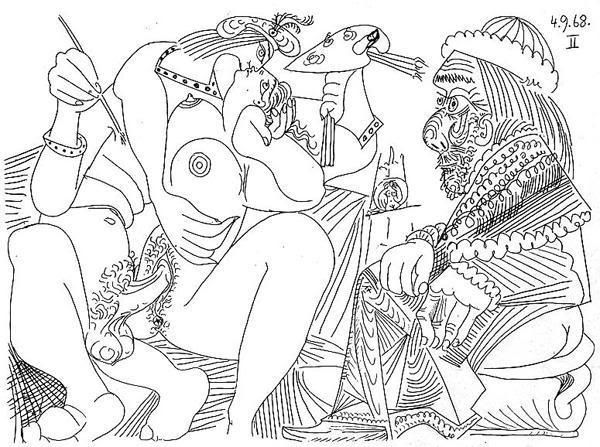
[The painter Picasso had a series of studies with himself as the old King watching young John making love to Desire herself.]
King Herods guards went to find John and took him prisoner. They brought him to Jerusalem with his hands tied behind his back and his robe pulled back to expose his genitals. Everyone in Jerusalem rushed to see.
After due exposure of John to the public eye, King Herod took John into his castle. He did not allow the public. He had the guards lock the gates, told the kitchen maids to stay in the kitchen, and then went with Salome and John under guard into his salon. The King had invited his brother and his wife to be his guests. A few chamberlains and chamber maids also sneaked in. The doors were shut behind them. They were in a large velvet crimson bedroom.
“What do you have to say for yourself, John,” asked Herod when John was sat down. “I hear that you do not know how to use that thing between your legs on women.”
“Oh, noble King,” answered John, “thou shalt not sleep with your brother’s wife.”
Herod’s brother’s wife Angelina hit John in the face with her fist.
“I understand what you are saying, John,” said King Herod. "Understanding things is not my trouble. However, I am troubled to hear that you will not get it up for women. If that is true, I will off with your head for sure.”
“Thou shall not sleep with ….” Before John could say the next word, a towel was wrapped around his mouth and tied tightly behind his head.
All torches and candles were put out but four candles. Then Princess Salome began her dance. She was covered by seven veils. She spun between the candles without the veils catching on flame—except when she tossed one directly onto one. Then the room lit up and revealed the next veil. It was bright yellow like the Sun that lights up the day.
The next veil after that was green, and then came orange. The fourth color was purple. Then came brown. It smelled like baked bread. Then came a pink one. The last was black. Then she stood before John almost naked.
John stood his ground and remained limp. His fantasy was unmoved.
Salome, the Princess of Desire in the heat of desire is challenged by John's immobility. She moved her underarm past John’s nose. John could not but have a sniff. John pretended not to like the smell of Salome.
Salome decided to waterboard John, but had the guards replace the water with wine. She made John drink two large gourds, at which point John had to piss where he was. Salome then ordered the guards to untie John’s mouth and put a whistle between his teeth. “That is all you will have to breathe if you do not get it up soon.” Salome let John blow his breath out through the whistle, but took it out for John to catch his breath. “I want to see you get it up, John,” said Salome, “or the next time you will breathe air through the whistle and it will be your last.”
John said unto himself: “Oh dear.” And he repeated “oh dear” many times. John also remembered what King Herod had said unto him about losing his head. He knew that he had to make up his mind to either get his Ding up, die for lack of breath, or lose his head. John decided to stay in charge of himself and lose his head.
Everyone may imagine what happened next. Salome did not give up easily. Perhaps she warmed up some butter and had it pored over John. Others may think of mayonnaise. Obviously, these are only two of a great many possibilities.
..............
So, how does this connect to NOT-VOTING? To insist there is one may seem odd, until you read that this story is in answer to the Latvian Pro-Vote team (LetUsVote www.ejambalsot.lv), which has put Kārlis Skalbe, a well known Latvian poet and writer of the first half of the 20th century, as the flag bearer of the pro-vote campaign. Unfortunately, Skalbe died more than a half a century ago, and his idea of Latvia is but myth now. Skalbe may be turning over in his grave, but his dream has to be imagined in another setting and in other ways today.
The only way that Latvia may survive in the future is through consciousness rising. Nevertheless, for twenty years the state has been dumbing the Latvian people down. As radical a move as recently made by Iceland to become a protectorate of the free word is perhaps thinkable in Latvia, but only a few will have thought of it or have other ideas how to make Latvia a place of need for the world. Most Latvian internet sites refuse to think controversial thoughts. The in-grown and nailed-down mentality of politicians rather has the country die. Therefore, be a NOT-VOTER!
Have a great Johns Eve eve.
[Next blog “Sex and Johns Eve (3)”. Conclusion.]
Asterisks & Other Readings
Compulsory voting in the EU Parliamentary elections
http://www.ceps.eu/files/book/1886.pdf
The abstentionist elephant
http://www.spiked-online.com/index.php/site/article/8783/
Electronic polls
http://news.bbc.co.uk/2/hi/technology/10102126.stm
On the Meaning of Voting
http://www.strike-the-root.com/92/bylund/bylund1.html
British Government Attempts to Bracket the Constitution
http://news.bbc.co.uk/2/hi/uk_news/politics/election_2010/8681624.stml
Ground Zero for Thought
http://www.alternet.org/module/printversion/146989
Why Forced Positive Thinking Is A Lot Of Crock?
http://www.alternet.org/story/146940/barbara_ehrenreich%3A_why_forced_positive_thinking_is_a_total_crock?page=2
If you copy this blog for your files, or copy to forward, or otherwise mention its content, please credit the author and http://esoschronicles.blogspot.com or http://the-not-voter.blogspot.com
I suggest you look at the links imbedded in these blogs or at the end of the blog as an integral part of my argument.
THE-NOT-VOTER
18 Sex and Johns Eve (2)
John the Water Curer (also known as John the Baptist) became overconfident. Freed from dependency on women all but in fantasy, John told King Herod that it was not good for him to sleep with his brother’s wife. He told the King that the whole community was beginning to imitate his behavior and it might become a tradition. Such behavior was breaking down the community, not building it up.
King Herod had not thought that the whole nation would begin to imitate him. So, his solution was to get John to shut up.
The trouble for the King was that John was confident, very confident. John was very much a sovereign over himself. There would be no secret police file on him. So he repeated his criticism, and again told King Herod that he better stop having sexual relations with his brother’s wife.
King Herod knew that he could not touch John by way of finding his behavior worse than his own. The secret path of celibacy was protecting John from attacks by Herod. While everyone knew what the secret was, Herod could not bring it into the open, because there was no man or woman who could claim to neever having relieved themselves of sexual tension by their own hand. Such a claim would make the claimer suspect of not being human.
King Herod wondered if there was some other way to trap John.
It happened that Herod had a daughter called Salome. Salome was a bad young woman. Her father had slept with her when she was fourteen and robbed her of all discretion in sexual matters. She had no inner sexual fantasy to speak of, because all her sexual fantasies could be realized. King Herod went to consult with Salome.
After Salome had heard King Herod out, she asked: “Does John have a girlfriend?”
“No,” answered the king.
“Then I know what his trouble is,” said Princess Salome. “He satisfies himself by his own hand. He is as much untouchable as is every woman’s challenge.”
“He must be stopped. I will chop off his hands,” said Herod.
“You cannot kill all the sheep,” answered Salome. “But I will dance for him,” the Princess added. “I will lure John out of himself. I will make him stand up.”
“John’s will not stand up for you or anybody but himself and his fantasy,” said King Herod. “I must make him shut up.”
“He will not shut up, father,” said Salome. “But don’t worry. I will have fun.”
“What will you do?” asked King Herod beginning to suspect something delicious in the offing.
“I will dance before John. You have the guards tie his hands behind him. Let them pull up his robe and wrap the hem of the robe under and around his arms at the back of his waist. Have them tie his ankles to the chair. Then I will dance before him.”
“Wow!” said King Herod.
“If you want to, you can watch,” said Princess Salome.
[The painter Picasso had a series of studies with himself as the old King watching young John making love to Desire herself.]
King Herods guards went to find John and took him prisoner. They brought him to Jerusalem with his hands tied behind his back and his robe pulled back to expose his genitals. Everyone in Jerusalem rushed to see.
After due exposure of John to the public eye, King Herod took John into his castle. He did not allow the public. He had the guards lock the gates, told the kitchen maids to stay in the kitchen, and then went with Salome and John under guard into his salon. The King had invited his brother and his wife to be his guests. A few chamberlains and chamber maids also sneaked in. The doors were shut behind them. They were in a large velvet crimson bedroom.
“What do you have to say for yourself, John,” asked Herod when John was sat down. “I hear that you do not know how to use that thing between your legs on women.”
“Oh, noble King,” answered John, “thou shalt not sleep with your brother’s wife.”
Herod’s brother’s wife Angelina hit John in the face with her fist.
“I understand what you are saying, John,” said King Herod. "Understanding things is not my trouble. However, I am troubled to hear that you will not get it up for women. If that is true, I will off with your head for sure.”
“Thou shall not sleep with ….” Before John could say the next word, a towel was wrapped around his mouth and tied tightly behind his head.
All torches and candles were put out but four candles. Then Princess Salome began her dance. She was covered by seven veils. She spun between the candles without the veils catching on flame—except when she tossed one directly onto one. Then the room lit up and revealed the next veil. It was bright yellow like the Sun that lights up the day.
The next veil after that was green, and then came orange. The fourth color was purple. Then came brown. It smelled like baked bread. Then came a pink one. The last was black. Then she stood before John almost naked.
John stood his ground and remained limp. His fantasy was unmoved.
Salome, the Princess of Desire in the heat of desire is challenged by John's immobility. She moved her underarm past John’s nose. John could not but have a sniff. John pretended not to like the smell of Salome.
Salome decided to waterboard John, but had the guards replace the water with wine. She made John drink two large gourds, at which point John had to piss where he was. Salome then ordered the guards to untie John’s mouth and put a whistle between his teeth. “That is all you will have to breathe if you do not get it up soon.” Salome let John blow his breath out through the whistle, but took it out for John to catch his breath. “I want to see you get it up, John,” said Salome, “or the next time you will breathe air through the whistle and it will be your last.”
John said unto himself: “Oh dear.” And he repeated “oh dear” many times. John also remembered what King Herod had said unto him about losing his head. He knew that he had to make up his mind to either get his Ding up, die for lack of breath, or lose his head. John decided to stay in charge of himself and lose his head.
Everyone may imagine what happened next. Salome did not give up easily. Perhaps she warmed up some butter and had it pored over John. Others may think of mayonnaise. Obviously, these are only two of a great many possibilities.
..............
So, how does this connect to NOT-VOTING? To insist there is one may seem odd, until you read that this story is in answer to the Latvian Pro-Vote team (LetUsVote www.ejambalsot.lv), which has put Kārlis Skalbe, a well known Latvian poet and writer of the first half of the 20th century, as the flag bearer of the pro-vote campaign. Unfortunately, Skalbe died more than a half a century ago, and his idea of Latvia is but myth now. Skalbe may be turning over in his grave, but his dream has to be imagined in another setting and in other ways today.
The only way that Latvia may survive in the future is through consciousness rising. Nevertheless, for twenty years the state has been dumbing the Latvian people down. As radical a move as recently made by Iceland to become a protectorate of the free word is perhaps thinkable in Latvia, but only a few will have thought of it or have other ideas how to make Latvia a place of need for the world. Most Latvian internet sites refuse to think controversial thoughts. The in-grown and nailed-down mentality of politicians rather has the country die. Therefore, be a NOT-VOTER!
Have a great Johns Eve eve.
[Next blog “Sex and Johns Eve (3)”. Conclusion.]
Asterisks & Other Readings
Compulsory voting in the EU Parliamentary elections
http://www.ceps.eu/files/book/1886.pdf
The abstentionist elephant
http://www.spiked-online.com/index.php/site/article/8783/
Electronic polls
http://news.bbc.co.uk/2/hi/technology/10102126.stm
On the Meaning of Voting
http://www.strike-the-root.com/92/bylund/bylund1.html
British Government Attempts to Bracket the Constitution
http://news.bbc.co.uk/2/hi/uk_news/politics/election_2010/8681624.stml
Ground Zero for Thought
http://www.alternet.org/module/printversion/146989
Why Forced Positive Thinking Is A Lot Of Crock?
http://www.alternet.org/story/146940/barbara_ehrenreich%3A_why_forced_positive_thinking_is_a_total_crock?page=2
If you copy this blog for your files, or copy to forward, or otherwise mention its content, please credit the author and http://esoschronicles.blogspot.com or http://the-not-voter.blogspot.com
Tuesday, June 15, 2010
Full or partial entries of my blogs may be found at LatviansOnline + Forum Home + Open Forum – The-Not-Voter. If you copy this blog for your files, or copy to forward, or otherwise mention its content, please credit the author and http://the-not-voter.blogspot.com/ or to this bloggers main site at http://esoschronicles.blogspot.com/
I suggest you look at the links imbedded in these blogs or at the end of the blog as an integral part of my argument.
THE-NOT-VOTER
17 An Arsenal of Ad Hominems
Ugly “art” is nothing new. After all, this will not be the first time that one has heard that “ugly is beautiful”. There are a number of theories why ugly art came to be and why it has became acceptable.
In-depth explanation of ugly art will demand a book. However, in a blog such as this it is perhaps excusable to occult, caleidescope, and abreviate complex issues by “jumping to conclusions”. Thus, I believe that for the most part, ugly art is related to the so-called Tourette's Syndrome, which through another mirror returns to us as an ad hominem.
Essentially ad hominem or, better, argumentum ad hominem is the logical fallacy of attempting to undermine a speaker's argument by attacking the speaker and not addressing the argument. To those who recognize the failure of logic in ad hominem arguments, the argument amounts to so much churning of air. This is why one attacked by ad hominem arguments is advised not to respond, because to respond means to fall into the trap of illogic, which may lead two or more persons not only into churning the air, but filling the air with vilifications advanced by negative self-exitation. It is a perfect illustration of "negative freedom" . Sometimes ad hominem slug fests a la ad hominem lead to blows and injuries.
A most curious ad hominem event occurred last Saturday with the reentry of Guntis Ulmanis, a former President of Latvia, into active political life by joining the party of oligarchs [a joint venture of The People’s (TP) and the First Party of Latvia (LPP)]. The entrenched “felt hats” have joined their forces and formed a new party, the All That’s Good for Latvia Party (VLL). Media sources reported that the public was as shocked by Ulmanis action as the media itself. No one had imagined such a possibility, given the former President’s harsh words against certain high positioned members of said parties.
One does not have to suffer from the Tourettes Syndrome and see and hear it expressed in shouted curses toward everyone who passes one by. The argument here is that Tourettes may manifest itself also as an attack ad hominem. Ad hominem attacks need not take the form of curses, but may projects themselves as ad hominem love strokes. If so, Guntis Ulmanis and his oligarch friends are stroking the public the best they know how. In short, they all are promising All That’s Good for Latvia to Latvians (excluding the Latvian Populists of course) with narry a chance that they will deliver.
Why is this blogger so negative? The reasons are several. Here are a few.
• 1. The oligarchs are not presenting themselves as “oligarchs”. They are presenting themselves as “uzņēmēji”, a Latvian word that straddles the meanings of such words or clusters of words as “enterprising people”, “business enterprises’, manufacturers, industrialists, “providers of jobs”, and above all the literal meaning of the word, i.e., ‘those who take on tasks’. The last is from the Latvian word “uzņemties”, to take on, to take responsibility for.
• 2. None of the oligarchs, and certainly not the former President, have suggested any specific direction Latvia ought to evolve toward in the future. Indeed, there is no vision of the future of Latvia other than a consumer culture and more indulgence of “negative freedom” (the word “negative” is of course never mentioned in oligarch parlance). The only direction that the All That’s Good for Latvia Party has heretofore proposed consists of
a) deflating the currency (Shkhehle-Šķēle, TP);
b) enlarging the Riga (RIX) airport (Shlesers, LPP);
c) aimless economic “growth”; aimlessness (other than personal enrichment) is now as established as the favorite activity of oligarchs.
d) While Guntis Ulmanis has spent his post-presidency years taking an active part in promoting Latvia’s hockey teams, he has no larger vision of the future than a world full of hockey. Perhaps he plans to back the Dvina-Dnepr River Canal Project, a project that may be compared to the project that built the Suez Canal. However, to realize such a project, one would have to tear down Latvia’s only hydroelectric dam on the Dvina.
e) Maybe Ulmanis has a plan that will persuade Latvians to tearing down the Kheguma Hydroelectric Dam. It will re-expose Staburags (the Hornpost) that was submerged by the dam’s waters in the Soviet era. It may again be used as a symbol of fortitude. The oligarchs will propose a private nuclear power station to replace the dam, but suggest that the transition from hydro to nuclear be will be hid from the public eye by through the continued use of the name “Khegums”.
• 3. The oligarchs are for economic growth left entirely in their hands, which know no better path forward than the one advocated by American neo-liberals and their European allies, who have brought the world the present financial and economic crisis. Hail! ten years of the Afghan war, more wars on the horizon, more than a hundred years of dumbing down the Middle and Working classes, and raise hope that the future will never end the days of conspicuous consumption or Pop Culture.
It will not have escaped the reader’s attention that an argumentum ad hominem is being used also by this blogger. I present an example of what the Tourettes Syndrome looks like when the above mentioned “love strokes” (the Latvian “paiya” or “glasts”) I try to imitate.
My “love stroke” for the oligarchs leaves no marks of aggression. To the contrary, I wonder if the devaluation now will do what it perhaps could have done at the beginning of our “time of troubles”. I am not convinced that it is not better if left be.
The airport. RIX, in Riga is a wonderful place, especially taking into consideration that in eighty or so years the tectonic shifts of our planet will submerge it and all of Riga. A long-term thinker would have built the airport near Yelgava, which will not be submerged by the dunking to come. After the flooding is over, we may see no more than a few of Riga’s church smiles and the top floors of some hotels. Bauska may start planning now where to build the harbor for leisure boats.
As for the Daugava-Dniepr Canal Project, I would rather reclaim the railroad tracks and replace the old tracks with tracks suitable for carrying a tele-capsule-for-two. If such a modernized version of the railroad were in place today, I would be among its first users, since the Aloja-Riga railroad line is but some 14 km drive from my home, and I am spared driving 35 km to Valmiera to catch a bus. Of course, we leave our car at the junction station, and off to Riga we go. We are transported back home by the same tele-capsule-for-two (private ownership encouraged), but on the opposite rail.
It is not at all unprecedented to claim one’s vision of the future against a vision that does not exist. And it should not surprise you that I encourage you to consider and NOT-TO-VOTE. I wish everyone to NOT-VOTE, because it is only by exercising such methods that the long repressed (dumbed down) citizenry has an opportunity to radically change their community’s socio-ecologic direction, rewrite their Latvian Constitution, the Latvian Satversme, and, yes, become a real community at last.
The next to join the (anti) ad hominem movement will be America. So! Why not be a real Latvian and do it first: I-WILL-NOT-VOTE.
[Next blog, Sex and Johns Eve (2) continued.]
Asterisks & Other Readings
Compulsory voting in the EU Parliamentary elections
http://www.ceps.eu/files/book/1886.pdf
The abstentionist elephant
http://www.spiked-online.com/index.php/site/article/8783/
Electronic polls
http://news.bbc.co.uk/2/hi/technology/10102126.stm
On the Meaning of Voting
http://www.strike-the-root.com/92/bylund/bylund1.html
British Government Attempts to Bracket the Constitution
http://news.bbc.co.uk/2/hi/uk_news/politics/election_2010/8681624.stml
Ground Zero for Thought
http://www.alternet.org/module/printversion/146989
Why Forced Positive Thinking Is A Lot Of Crock?
http://www.alternet.org/story/146940/barbara_ehrenreich%3A_why_forced_positive_thinking_is_a_total_crock?page=2
If you copy this blog for your files, or copy to forward, or otherwise mention its content, please credit the author and http://esoschronicles.blogspot.com or http://the-not-voter.blogspot.com
I suggest you look at the links imbedded in these blogs or at the end of the blog as an integral part of my argument.
THE-NOT-VOTER
17 An Arsenal of Ad Hominems
Ugly “art” is nothing new. After all, this will not be the first time that one has heard that “ugly is beautiful”. There are a number of theories why ugly art came to be and why it has became acceptable.
In-depth explanation of ugly art will demand a book. However, in a blog such as this it is perhaps excusable to occult, caleidescope, and abreviate complex issues by “jumping to conclusions”. Thus, I believe that for the most part, ugly art is related to the so-called Tourette's Syndrome, which through another mirror returns to us as an ad hominem.
Essentially ad hominem or, better, argumentum ad hominem is the logical fallacy of attempting to undermine a speaker's argument by attacking the speaker and not addressing the argument. To those who recognize the failure of logic in ad hominem arguments, the argument amounts to so much churning of air. This is why one attacked by ad hominem arguments is advised not to respond, because to respond means to fall into the trap of illogic, which may lead two or more persons not only into churning the air, but filling the air with vilifications advanced by negative self-exitation. It is a perfect illustration of "negative freedom" . Sometimes ad hominem slug fests a la ad hominem lead to blows and injuries.
A most curious ad hominem event occurred last Saturday with the reentry of Guntis Ulmanis, a former President of Latvia, into active political life by joining the party of oligarchs [a joint venture of The People’s (TP) and the First Party of Latvia (LPP)]. The entrenched “felt hats” have joined their forces and formed a new party, the All That’s Good for Latvia Party (VLL). Media sources reported that the public was as shocked by Ulmanis action as the media itself. No one had imagined such a possibility, given the former President’s harsh words against certain high positioned members of said parties.
One does not have to suffer from the Tourettes Syndrome and see and hear it expressed in shouted curses toward everyone who passes one by. The argument here is that Tourettes may manifest itself also as an attack ad hominem. Ad hominem attacks need not take the form of curses, but may projects themselves as ad hominem love strokes. If so, Guntis Ulmanis and his oligarch friends are stroking the public the best they know how. In short, they all are promising All That’s Good for Latvia to Latvians (excluding the Latvian Populists of course) with narry a chance that they will deliver.
Why is this blogger so negative? The reasons are several. Here are a few.
• 1. The oligarchs are not presenting themselves as “oligarchs”. They are presenting themselves as “uzņēmēji”, a Latvian word that straddles the meanings of such words or clusters of words as “enterprising people”, “business enterprises’, manufacturers, industrialists, “providers of jobs”, and above all the literal meaning of the word, i.e., ‘those who take on tasks’. The last is from the Latvian word “uzņemties”, to take on, to take responsibility for.
• 2. None of the oligarchs, and certainly not the former President, have suggested any specific direction Latvia ought to evolve toward in the future. Indeed, there is no vision of the future of Latvia other than a consumer culture and more indulgence of “negative freedom” (the word “negative” is of course never mentioned in oligarch parlance). The only direction that the All That’s Good for Latvia Party has heretofore proposed consists of
a) deflating the currency (Shkhehle-Šķēle, TP);
b) enlarging the Riga (RIX) airport (Shlesers, LPP);
c) aimless economic “growth”; aimlessness (other than personal enrichment) is now as established as the favorite activity of oligarchs.
d) While Guntis Ulmanis has spent his post-presidency years taking an active part in promoting Latvia’s hockey teams, he has no larger vision of the future than a world full of hockey. Perhaps he plans to back the Dvina-Dnepr River Canal Project, a project that may be compared to the project that built the Suez Canal. However, to realize such a project, one would have to tear down Latvia’s only hydroelectric dam on the Dvina.
e) Maybe Ulmanis has a plan that will persuade Latvians to tearing down the Kheguma Hydroelectric Dam. It will re-expose Staburags (the Hornpost) that was submerged by the dam’s waters in the Soviet era. It may again be used as a symbol of fortitude. The oligarchs will propose a private nuclear power station to replace the dam, but suggest that the transition from hydro to nuclear be will be hid from the public eye by through the continued use of the name “Khegums”.
• 3. The oligarchs are for economic growth left entirely in their hands, which know no better path forward than the one advocated by American neo-liberals and their European allies, who have brought the world the present financial and economic crisis. Hail! ten years of the Afghan war, more wars on the horizon, more than a hundred years of dumbing down the Middle and Working classes, and raise hope that the future will never end the days of conspicuous consumption or Pop Culture.
It will not have escaped the reader’s attention that an argumentum ad hominem is being used also by this blogger. I present an example of what the Tourettes Syndrome looks like when the above mentioned “love strokes” (the Latvian “paiya” or “glasts”) I try to imitate.
My “love stroke” for the oligarchs leaves no marks of aggression. To the contrary, I wonder if the devaluation now will do what it perhaps could have done at the beginning of our “time of troubles”. I am not convinced that it is not better if left be.
The airport. RIX, in Riga is a wonderful place, especially taking into consideration that in eighty or so years the tectonic shifts of our planet will submerge it and all of Riga. A long-term thinker would have built the airport near Yelgava, which will not be submerged by the dunking to come. After the flooding is over, we may see no more than a few of Riga’s church smiles and the top floors of some hotels. Bauska may start planning now where to build the harbor for leisure boats.
As for the Daugava-Dniepr Canal Project, I would rather reclaim the railroad tracks and replace the old tracks with tracks suitable for carrying a tele-capsule-for-two. If such a modernized version of the railroad were in place today, I would be among its first users, since the Aloja-Riga railroad line is but some 14 km drive from my home, and I am spared driving 35 km to Valmiera to catch a bus. Of course, we leave our car at the junction station, and off to Riga we go. We are transported back home by the same tele-capsule-for-two (private ownership encouraged), but on the opposite rail.
It is not at all unprecedented to claim one’s vision of the future against a vision that does not exist. And it should not surprise you that I encourage you to consider and NOT-TO-VOTE. I wish everyone to NOT-VOTE, because it is only by exercising such methods that the long repressed (dumbed down) citizenry has an opportunity to radically change their community’s socio-ecologic direction, rewrite their Latvian Constitution, the Latvian Satversme, and, yes, become a real community at last.
The next to join the (anti) ad hominem movement will be America. So! Why not be a real Latvian and do it first: I-WILL-NOT-VOTE.
[Next blog, Sex and Johns Eve (2) continued.]
Asterisks & Other Readings
Compulsory voting in the EU Parliamentary elections
http://www.ceps.eu/files/book/1886.pdf
The abstentionist elephant
http://www.spiked-online.com/index.php/site/article/8783/
Electronic polls
http://news.bbc.co.uk/2/hi/technology/10102126.stm
On the Meaning of Voting
http://www.strike-the-root.com/92/bylund/bylund1.html
British Government Attempts to Bracket the Constitution
http://news.bbc.co.uk/2/hi/uk_news/politics/election_2010/8681624.stml
Ground Zero for Thought
http://www.alternet.org/module/printversion/146989
Why Forced Positive Thinking Is A Lot Of Crock?
http://www.alternet.org/story/146940/barbara_ehrenreich%3A_why_forced_positive_thinking_is_a_total_crock?page=2
If you copy this blog for your files, or copy to forward, or otherwise mention its content, please credit the author and http://esoschronicles.blogspot.com or http://the-not-voter.blogspot.com
Subscribe to:
Posts (Atom)